

When a life insurance policy is held inside an Irrevocable Life Insurance Trust, most families assume their options are limited to one of two paths: keep paying the premiums or surrender the policy back to the insurance company for whatever the carrier is willing to offer. Neither option tends to sit well with trustees or beneficiaries who have watched years of premium payments accumulate with little to show for them. Fortunately, there may be another solution, prompting many trustees to ask: can a life insurance policy in an irrevocable trust be sold?
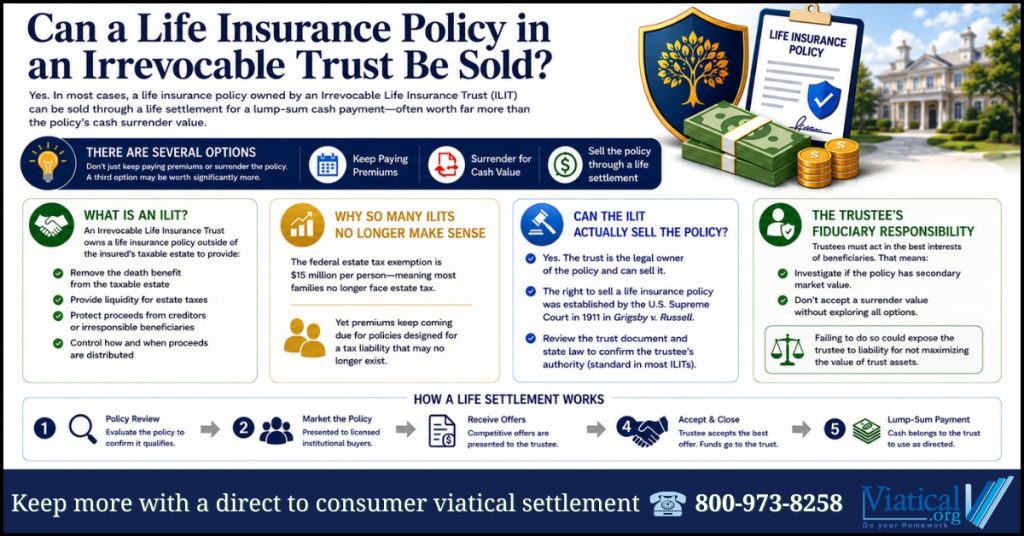
What many trustees, attorneys, and families do not realize is that a third option exists, and it can be worth significantly more than either of the alternatives they are already aware of. A life insurance policy held inside an ILIT may qualify for life settlements, allowing the trust to sell the policy to a licensed institutional buyer in exchange for a lump-sum cash payment. That payment belongs to the trust, and in many cases, it represents far more than the policy’s stated cash surrender value.
At Viatical.org, we have worked with families, trustees, and their advisors on both ends of this transaction, helping people establish the strategic value of a policy inside a trust, and helping others exit a trust-owned policy when the original estate planning purpose no longer applies. This is not theoretical territory for us. It is work we have done, and we can help you understand whether your situation qualifies.
What Is an Irrevocable Life Insurance Trust?
An Irrevocable Life Insurance Trust, commonly referred to as an ILIT, is a legal structure specifically designed to own a life insurance policy outside of the insured’s taxable estate. Once established, the trust becomes the legal owner and beneficiary of the policy. The person who created the trust, known as the grantor, relinquishes ownership and control of the policy in exchange for the estate planning benefits the structure provides.
ILITs are typically created for one or more of the following reasons:
- To remove the life insurance death benefit from the insured’s taxable estate
- To provide liquidity for estate taxes without subjecting the proceeds to taxation
- To protect the death benefit from creditors or irresponsible beneficiaries
- To maintain control over how and when proceeds are distributed after death
For decades, this structure made excellent financial sense, particularly for high-net-worth individuals whose estates were likely to exceed the federal estate tax exemption. A well-funded ILIT holding a large permanent life insurance policy was considered a cornerstone of sophisticated estate planning.
That calculus has shifted significantly for many families. And for some, the policy sitting inside the trust has become more of a financial burden than a benefit.
Why So Many ILITs No Longer Make Sense
The federal estate tax exemption has changed dramatically over the years, and recent legislation has accelerated that shift. The exemption currently stands at $15 million per person, which means the vast majority of Americans, including many who were once legitimately concerned about estate tax exposure, no longer face any federal estate tax liability whatsoever.
The policies inside their ILITs, however, did not get that memo. Premiums continue to come due. The trustee continues to manage the policy. And families continue to fund Crummey notices year after year for a tax-planning purpose that, for many of them, no longer exists.
At Viatical.org, we have spoken with adult children who are co-trustees of ILITs their parents established twenty years ago, paying tens of thousands of dollars annually in premiums on policies that were designed to offset an estate tax liability that has effectively disappeared. The frustration is understandable. And in many cases, it is entirely solvable.
Can the ILIT Actually Sell the Policy?
Yes, in most cases, the answer is yes.
A life insurance policy is property. As the legal owner of that property, the trust has the right to sell it, subject to the terms of the trust document and applicable state law. The trustee acts on behalf of the trust and exercises its ownership rights, including the right to sell the policy to a third-party buyer in a life settlement transaction.
This is not a legal gray area. The right of a policy owner to sell a life insurance policy to a willing buyer was established by the United States Supreme Court in 1911 in Grigsby v. Russell, and that principle has been the legal foundation of the life settlement industry ever since. The trust owns the policy. The trust can sell the policy.
What matters in practice is reviewing the trust document itself to confirm that the trustee has the authority to sell trust assets, which is standard language in virtually all properly drafted ILITs. An estate planning attorney can confirm this in short order if there is any question.
The Trustee’s Fiduciary Responsibility
This is a point that deserves emphasis, and it is one that many trustees are not fully aware of.
A trustee has a fiduciary duty to act in the best interests of the trust’s beneficiaries. That duty includes the obligation to make informed decisions about trust assets, and a life insurance policy is a trust asset. Surrendering a policy to the insurance company for its cash surrender value without first investigating whether it has secondary market value is, in some circumstances, a failure of that fiduciary duty.
Legal commentary in the estate planning community has made this point with increasing urgency. Trustees who allow policies to lapse or accept surrender values without exploring the life settlement market may be exposing themselves to liability for failing to maximize the value of trust assets on behalf of beneficiaries.
We have worked directly with trustees who came to us specifically because their legal counsel raised this issue during a policy review. In each of those cases, the secondary market value of the policy exceeded what the insurance company had offered, sometimes by a substantial margin.
If you are a trustee of an ILIT, getting the policy appraised is not optional. It is part of doing your job correctly.
How a Life Settlement Works When the Policy Is Trust-Owned
The mechanics of a trust-owned life settlement follow the same general process as any other life settlement, with a few structural considerations that reflect the trust’s ownership role.
Step 1: Confirm Trustee Authority
The trust document is reviewed to confirm that the trustee has the authority to sell trust assets. This is standard language in most ILITs, but it should be verified before the process begins.
Step 2: Policy Appraisal
The Viatical.org platform gathers the information needed to conduct a proper policy appraisal. This includes the current policy illustration, the in-force ledger, premium obligations, and the relevant health information for the insured or insureds. There is no application fee and no obligation at this stage.
Step 3: Underwriting and Offer
Licensed institutional buyers review the policy and the health profile of the insured. If the policy has secondary market value, offers are presented to the trust. The trustee evaluates those offers in light of the trust’s obligations to its beneficiaries.
Step 4: Trustee Acceptance and Closing
If the trustee accepts an offer, closing documents are generated by a licensed provider in the applicable state. Viatical.org typically arranges a notary to assist with the signing process. Change of ownership and beneficiary documents are then submitted to the insurance carrier.
Step 5: Funding
Once the insurance company confirms the change of ownership, the funds held in escrow are released to the trust. From that point forward, the institutional buyer is responsible for all future premium payments and receives the death benefit when the insured passes away.
What Policies Inside an ILIT May Qualify
Not every policy held in trust will qualify for a life settlement, but many more qualify than people expect. Policies most likely to have secondary market value include:
Guaranteed Universal Life (GUL) These policies are particularly attractive to institutional buyers because of their low-cost death benefit guarantees and predictable premium structures.
Second-to-Die (Survivorship) Life Insurance A large portion of ILIT-held policies are survivorship policies, which pay the death benefit after both insureds have passed away. These policies are evaluated based on the combined life expectancy of both insured individuals. If one spouse has passed or both have experienced health changes, the policy may carry significant secondary market value.
Whole Life Insurance Properly funded whole life policies held in trust can also qualify, particularly for older insureds with adverse health changes.
Convertible Term Life Insurance If the term policy inside the trust still carries an active conversion privilege, it may have settlement value, especially for an insured whose health has changed since the policy was originally issued.
The Estate Tax Exemption Change: A Specific Situation to Watch
We want to address this directly, because we are hearing from more families about it as awareness grows.
If an ILIT was established primarily to provide liquidity for federal estate taxes, and the estate in question is now well below the current $15 million per person federal exemption, the original purpose of that trust, and the policy it holds, may no longer apply. That does not mean the trust has no value. It means the policy inside it may have a different kind of value: one that can be accessed right now, rather than at death.
We have helped families in exactly this situation. The conversation typically starts with a trustee or an adult child asking whether it makes sense to keep paying premiums on a policy that was designed for a tax problem that no longer exists. In most of those conversations, the answer is the same: have the policy appraised before you make any decision. The surrender value the insurance company offers is rarely the full story.
What Happens to the Beneficiaries?
This is one of the most common concerns raised by trustees and family members when the idea of selling an ILIT-held policy comes up.
It depends, and the details matter.
If the policy is sold outright in a life settlement, the trust receives the cash proceeds. Those proceeds become trust assets and are distributed or managed according to the terms of the trust document. The beneficiaries of the trust receive those funds rather than a future death benefit, which, depending on the trust’s terms, may happen immediately or at a specified future point.
In some cases, a retained death benefit may be negotiable as part of the settlement structure, allowing the trust to sell a portion of the policy while preserving some death benefit for the beneficiaries. This is not available in every transaction, but it is worth exploring when family protection remains a consideration.
The right answer depends on the specific terms of the trust, the needs of the beneficiaries, and the offers available in the secondary market. These are exactly the kinds of conversations we have with families and their advisors on a regular basis.
Frequently Asked Questions About Life Settlements and ILITs
Can an irrevocable trust sell a life insurance policy?
Yes. The trust, as the legal owner of the policy, has the right to sell it. The trustee exercises that right on behalf of the trust’s beneficiaries, subject to the terms of the trust document. In virtually all properly drafted ILITs, the trustee has express authority to manage and sell trust assets. If there is any ambiguity in the trust language, an estate planning attorney can provide a straightforward opinion. We recommend getting that confirmation before initiating the appraisal process, though it is rarely an obstacle.
What is the trustee’s obligation before surrendering an ILIT policy?
A trustee has a fiduciary duty to act in the best financial interests of the trust’s beneficiaries. That duty extends to the disposition of trust assets, including life insurance policies. Before surrendering a policy to the insurance company for its cash surrender value, a trustee is expected to investigate whether superior alternatives exist. The life settlement market is one such alternative, and failure to consider it before accepting a surrender value has been cited in legal commentary as a potential breach of fiduciary duty. At Viatical.org, we provide appraisals at no cost and with no obligation, specifically to help trustees fulfill this responsibility.
How is a trust-owned life settlement different from a standard life settlement?
The underlying transaction is largely the same. The key difference is that the trust, rather than an individual, is the seller. The trustee signs on behalf of the trust, and the settlement proceeds are paid to the trust rather than to an individual policyholder. The same underwriting factors apply: the age and health of the insured or insureds, the face value of the policy, the premium obligations, and the policy type. We have extensive experience supporting trustees, their attorneys, and their financial advisors throughout the process.
Does selling the ILIT policy affect Medicaid or Social Security?
This question typically arises when one or both of the insureds are receiving or anticipating needs-based benefits. The answer depends on how the trust is structured and the specific benefit programs involved. Because the policy is owned by a trust rather than the individual, the proceeds from a sale go to the trust, not directly to the insured. This distinction matters and should be reviewed with a benefits planning attorney before proceeding. We are happy to speak with your legal counsel directly.
What if one insured in a survivorship policy has already passed away?
This is actually a situation that can significantly increase the secondary market value of a survivorship policy. Once one of the two insureds has passed, the remaining insured’s life expectancy becomes the primary underwriting variable, and institutional buyers often find these policies quite attractive. If you are a trustee or family member dealing with this situation, we strongly encourage you to have the policy appraised before making any decisions about surrendering or lapsing it.
Can the trust keep some of the death benefit and still sell?
In some cases, yes. A retained death benefit arrangement allows the policy to be partially sold, with the trust receiving a cash payment today while preserving a portion of the death benefit for beneficiaries. Not every buyer offers this structure, and it is not available for every policy. However, it is a real option that we have helped arrange for families where preserving some level of protection remained important. It is worth asking about during the appraisal process.
How long does a trust-owned life settlement take?
From initial appraisal to funding, most transactions take between 60 and 90 days, though timelines vary depending on the complexity of the trust, the responsiveness of the insurance carrier in providing documents, and how quickly the underwriting process moves. The Viatical.org platform is designed to accelerate document gathering and keep the process moving. For trustees who are managing ongoing premium obligations on a policy that may have settlement value, time matters, and we treat it accordingly.
Does the ILIT need to be dissolved to sell the policy?
No. The trust does not need to be dissolved or terminated to sell the policy. The trust sells the policy as the legal owner, receives the proceeds, and continues to exist in accordance with its terms. What happens to the trust after the sale is a matter between the trustee, the beneficiaries, and the trust’s legal counsel. Some trusts are wound down after the sale. Others remain in place and the proceeds are managed or distributed according to the trust document. This is outside the scope of what Viatical.org manages, but we are accustomed to working alongside estate planning attorneys who handle that side of the transaction.
What if the policy inside the ILIT is term insurance that is about to expire?
This is an urgent situation and needs to be addressed immediately. If the term policy inside the ILIT still has an active conversion privilege, that conversion option is often precisely what makes the policy attractive to secondary market buyers. Once the conversion window closes, the policy may lose its settlement value entirely. If you are a trustee who has become aware that a term policy inside the trust is approaching the end of its level term or conversion period, call us today. This is the type of situation where a short conversation can prevent the permanent loss of a significant financial asset.
How does Viatical.org work with trustees and attorneys?
We are experienced in working directly with the full professional team involved in a trust-related settlement. That includes the trustee, the estate planning attorney, the financial advisor, and in some cases the trust’s accountant. We provide clear documentation of the appraisal process and the offers received, which trustees and their counsel can use to demonstrate that due diligence was performed. We understand that trustees are operating under legal obligations, and we structure our involvement to support rather than complicate that process. A call with us costs nothing. The appraisal costs nothing. And the clarity you gain from both is significant.
Do Your Homework
If you are a trustee, a beneficiary, an attorney, or an advisor who is responsible for a life insurance policy held inside an Irrevocable Life Insurance Trust, or if you are a family member trying to understand your options, the single most important step you can take right now is to have the policy appraised.
You do not have to accept the insurance company’s surrender value. You do not have to keep paying premiums on a policy that no longer serves its original purpose. And you do not have to make any decision without first understanding what the policy may actually be worth in the secondary market.
Viatical.org has been doing this work for more than 20 years. When an ILIT held policy no longer serves its purpose, we help trustees and families find a straightforward path out and we do it without the layers of intermediaries that drive down the final number.
Call us at 800-973-8258. The conversation is free. The appraisal is free. And what you learn may change the financial outcome for your family significantly.
 DO YOU QUALIFY?