

When a policyowner no longer needs coverage or wants to stop paying premiums, a common question arises: can you sell a joint life insurance policy for cash? In some situations, the answer may be yes. Certain joint policies, often called survivor or second-to-die life insurance policies, may qualify for a life settlement, allowing the policyowner to sell the policy to a licensed purchaser in exchange for a lump-sum payment. Understanding how these policies work can help determine whether selling the policy may be an alternative to surrendering it or letting it lapse.
What Is a Joint Life Insurance Policy?
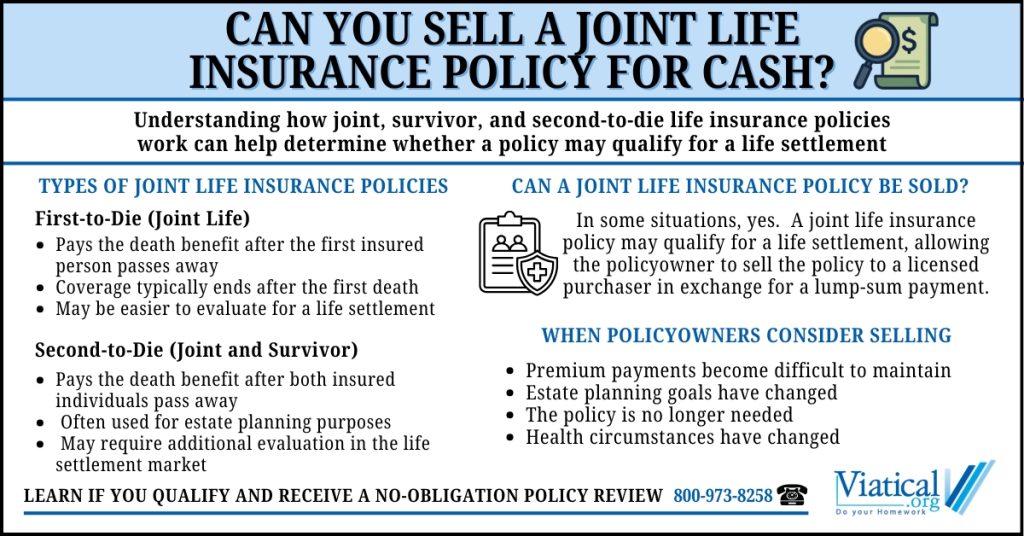
A joint life insurance policy covers two insured individuals under a single contract. These policies are commonly used by spouses for estate planning or financial protection.
There are two primary structures:
First-to-die (joint life)
- The policy pays the death benefit after the first insured person passes away.
- Coverage ends after the first death.
Second-to-die (joint and survivor)
- Also called a survivorship policy.
- The death benefit is paid only after both insured individuals have passed away.
Because of the way benefits are triggered, these policies behave differently when evaluated for life settlements.
Can a Joint or Survivor Policy Be Sold?
In some cases, yes, a joint life insurance policy can be sold for cash through a life settlement. However, eligibility depends on several factors and how the policy is structured.
Settlement purchasers typically review several factors:
- Policy type (first-to-die or second-to-die)
- Death benefit size
- Age and health of the insured individuals
- Premium obligations
- Policy ownership and transfer rights
Life settlement purchasers review several factors when evaluating a policy, including the age and health of the insured individuals, the death benefit, and the premium obligations.
Why Second-to-Die Policies Are Evaluated Differently
A second-to-die life insurance policy, also known as a joint and survivor policy, is commonly used for estate planning. The benefit is often intended to help heirs cover estate taxes or preserve assets after both spouses pass away.
Because a second-to-die policy depends on the life expectancy of two insured individuals, evaluating these policies requires a more detailed review. However, some joint and survivor policies may still qualify for a life settlement depending on the policy structure and the health of the insured individuals.
Situations Where a Joint Policy May Be Considered
While not every policy qualifies, certain situations can qualify:
- The policy has a large death benefit
- One or both insured individuals have experienced significant health changes
- Premium payments have become difficult to maintain
- The original estate planning purpose of the policy no longer applies
In these cases, evaluating the policy may help determine whether selling the policy is possible or whether other options may be more practical. Every case is unique and it is always best to get a life settlement appraisal.
Alternatives to Letting the Policy Lapse
When policyowners no longer want or need coverage, they often assume their only options are to keep paying premiums or cancel the policy. However, a joint policy may have several potential paths depending on its structure.
Possible options may include:
- Maintaining the policy if it still serves an estate planning purpose
- Surrendering the policy to the insurance company for any available cash value
- Reducing coverage if the policy allows adjustments
- Exploring a life settlement appraisal to determine if selling the policy is possible
Because joint policies vary widely, reviewing the contract details is an important first step.
Determining Whether a Joint Policy Has Value
If you own a joint life, joint and survivor, or second-to-die life insurance policy, the best way to understand your options is to have the policy reviewed. A settlement appraisal can help determine whether the policy qualifies for the secondary market and whether purchasers may be interested.
In many cases, this type of evaluation takes only a few minutes and can provide clarity about whether selling the policy is possible or whether another option may make more financial sense. To learn if your policy qualifies, please give us a call today. 800-973-8258
 DO YOU QUALIFY?