

If you have received a life insurance buyback offer get a direct buyout quote before accepting your insurance company’s offer to surrender your policy. You may be able to sell your coverage to a third-party buyer through a transaction known as a life settlement. Depending on your age, health, and policy details, a life settlement could provide a payment substantially higher than the amount your insurance company has offered.
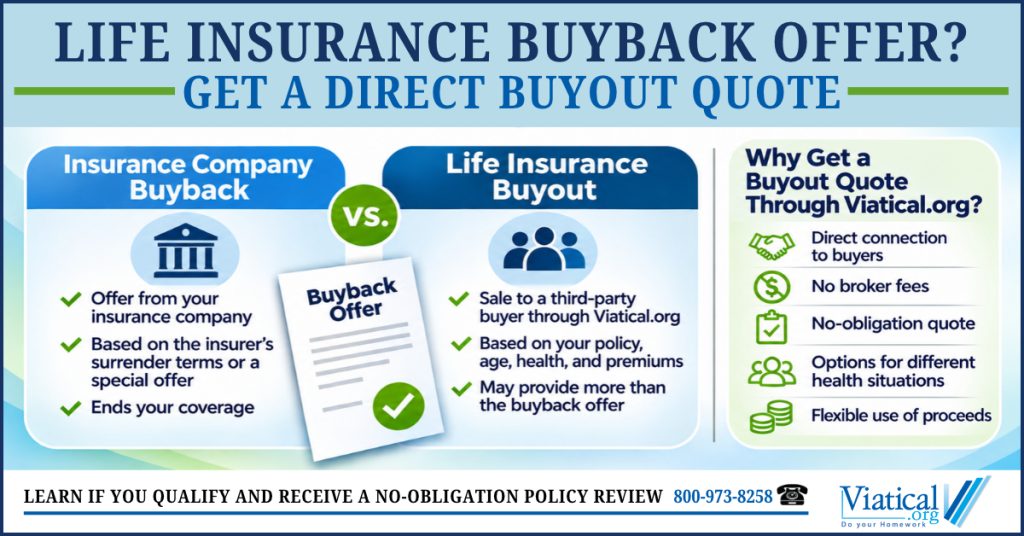
Depending on your age, health, and policy details, a life settlement could provide a payment substantially higher than the amount your insurance company has offered.
Viatical.org helps policy owners explore life insurance buyout opportunities by connecting them directly with buyers, without broker fees deducted from their settlement proceeds. Before accepting a buyback offer or surrendering your policy, it is worth finding out if your policy has a hidden value beyond what the insurance company is offering.
What Is a Life Insurance Buyback Offer?
A life insurance buyback offer generally refers to an insurance company’s offer to pay a policyholder to surrender or terminate an existing life insurance policy.
In many cases, policyholders who surrender permanent life insurance receive the policy’s available cash surrender value. However, some insurance companies have offered enhanced surrender payments as an incentive for policyholders to give up their coverage.
These offers may be presented through letters or other communications and can include a deadline for acceptance.
If you have received a buyback offer, whether recently or several years ago, it may be worth exploring your alternatives before making a decision.
The amount an insurance company offers to surrender a policy does not necessarily reflect what an independent buyer may be willing to pay for it.
What Is a Life Insurance Buyout?
A life insurance buyout generally refers to selling an existing life insurance policy to a third-party buyer for a lump-sum cash payment.
This type of transaction is commonly known as a life settlement or, when certain health-related requirements are met, a viatical settlement.
Instead of surrendering your policy to the insurance company, you transfer ownership and beneficiary rights to the buyer. The buyer typically assumes responsibility for future premiums and receives the death benefit when the insured passes away.
The amount a buyer may offer depends on several factors, including:
- The policy’s death benefit
- The insured person’s age and health
- The type of life insurance policy
- Future premium requirements
- The policy’s existing cash value, if any
Unlike a traditional policy surrender, a life settlement considers the value of the policy to a third-party buyer.
Through Viatical.org, eligible policyholders can connect directly with buyers to explore settlement opportunities without paying broker fees.
Life Insurance Buyback vs. Life Insurance Buyout
Although the terms are sometimes used interchangeably, there are important differences between surrendering a policy to your insurance company and selling it to a third-party buyer.
| Insurance Company Buyback | Life Insurance Buyout | |
| Who pays you? | Your insurance company | A third-party buyer |
| How is the payment determined? | Insurer’s surrender terms or special offer | Policy characteristics and buyer valuation |
| Potential payment | Cash surrender value or an enhanced offer | May exceed the surrender value |
| Future premiums | End when the policy terminates | Generally assumed by the buyer |
| Death benefit | Coverage terminates | Buyer generally receives the benefit |
| Broker fees | Generally not applicable | No broker fees through Viatical.org |
Both options involve giving up your policy and its death benefit. However, the amount you receive can differ significantly.
Comparing available options before making a final decision can help you determine which approach makes the most financial sense.
Why Would an Insurance Company Offer to Buy Back a Policy?
Insurance companies may offer to buy back certain policies for a variety of financial and business reasons. Some older life insurance policies contain guarantees or other contractual provisions that are more expensive for insurers to maintain than originally anticipated.
By offering policyholders a payment to surrender these policies, an insurer may be able to reduce its future financial obligations. For the policyholder, an enhanced buyback offer may appear attractive, particularly when it exceeds the policy’s stated cash surrender value.
However, an insurer’s offer is based on its own financial considerations. A third-party buyer evaluates the policy differently. This is why it can be beneficial to explore a life settlement before accepting a buyback offer.
Could Your Life Insurance Policy Be Worth More Than the Buyback Offer?
In some circumstances, a life insurance policy may have a market value that far exceeds the amount offered by the issuing insurance company.
For example, a policyholder may receive an enhanced surrender offer based on the insurer’s assessment of the policy. A third-party buyer may place a higher value on the same coverage after considering the insured person’s age, health, death benefit, and anticipated premium costs.
The difference can be particularly meaningful when the insured person’s health has changed. However, not every policy qualifies for a life settlement, and a third-party offer is not guaranteed to exceed an insurer’s buyback amount. The most reliable way to evaluate your options is to obtain a settlement quote and compare it with the offer you have already received.
How Does Your Health Affect a Life Insurance Buyout?
Health is an important factor in determining the potential value of a life insurance policy in the secondary market. When evaluating a policy, buyers consider the insured person’s estimated life expectancy along with the death benefit and future premiums.
If the insured has developed a serious medical condition or experienced a significant decline in health, the policy may become more attractive to certain buyers. As a result, a policy with little cash surrender value may still qualify for a meaningful settlement payment.
For individuals facing serious or terminal illnesses, a viatical settlement may provide access to funds that can be used for medical expenses, living costs, debt, or other financial needs. Settlement proceeds generally have no restrictions on how they may be spent.
A decline in health does not automatically guarantee a higher settlement offer, but it is an important reason to have your policy evaluated before surrendering it.
Can Healthy People Qualify for a Life Insurance Buyout?
Yes – you do not have to be seriously ill to qualify for a life settlement.
Although health conditions can influence settlement values, many healthy older adults may also qualify based on their age and policy characteristics.
General eligibility considerations include:
- Age: Life settlements are commonly available to policyholders age 65 and older, although younger individuals may qualify under certain circumstances.
- Policy type: Universal life and whole life policies are commonly considered. Some term life policies may also qualify, particularly when they include a conversion option.
- Death benefit: Many buyers prefer policies with death benefits of at least $100,000, although requirements vary.
- Premium costs: The amount required to keep the policy active can influence buyer interest and settlement value.
If you have a policy you no longer need or can no longer afford, exploring a life settlement may be worthwhile even if you are in good health.
What If You Received a Buyback Offer Years Ago?
You may still have options, provided your life insurance policy remains active. An offer received several years ago does not necessarily reflect what your policy could be worth today.
Changes in your age, health, policy premiums, and market conditions can all affect the amount a buyer may be willing to pay.
If you previously received a letter from your insurance company but decided to keep your coverage, you can still explore a life settlement. However, if the policy has already been surrendered or terminated, it cannot be sold.
Why Explore a Life Insurance Buyout Through Viatical.org?
Viatical.org provides a direct-to-buyer platform for policyholders interested in selling their life insurance coverage. Rather than working through a traditional life settlement broker, policyholders can explore opportunities directly with buyers.
Benefits include:
- Direct buyer access: Explore life settlement opportunities without a traditional broker acting as an intermediary.
- No broker fees: No broker commissions are deducted from your settlement proceeds.
- No-obligation quotes: Find out whether your policy may qualify without committing to a sale.
- Options for different health situations: Both healthy older adults and individuals with serious medical conditions may qualify.
- Flexible use of proceeds: Settlement funds can generally be used for any purpose.
Whether you have received a buyback offer from your insurance company or are simply considering surrendering an unwanted policy, Viatical.org can help you explore another potential source of value.
Frequently Asked Questions About Life Insurance Buyouts
Is a life insurance buyback the same as a life settlement?
Not necessarily. A buyback typically refers to an insurance company’s offer to pay a policyholder to surrender or terminate coverage. A life settlement involves selling the policy to a third-party buyer who assumes ownership and generally becomes responsible for future premiums.
Can I get more money from a life settlement than an insurance company buyback?
Some life settlements provide substantially more than a policy’s cash surrender value or an insurer’s enhanced buyback offer. The amount depends on the insured person’s age and health, policy terms, and buyer interest.
Can I sell a life insurance policy with no cash value?
Yes, in some circumstances. A policy does not necessarily need accumulated cash value to qualify for a settlement. Certain term policies, particularly those with conversion privileges, may qualify depending on the insured person’s circumstances and the policy’s provisions.
Do I need to be sick to sell my life insurance policy?
Healthy older adults may qualify for traditional life settlements. Individuals with serious or terminal illnesses may also qualify for viatical settlements.
Does Viatical.org charge broker fees?
Viatical.org connects policyholders directly with buyers, and no broker fees are deducted from the direct offer presented to you.
Are life insurance buyout proceeds taxable?
Tax treatment depends on the type of settlement, the policyholder’s circumstances, and applicable tax laws. Certain qualifying viatical settlement proceeds may be excluded from federal income taxation. Consult a qualified tax professional about your specific situation.
Should I accept my insurance company’s buyback offer?
Before accepting, consider whether the policy may qualify for a life settlement. Comparing the insurer’s offer with a potential third-party settlement can help you make a more informed decision. You should also consider whether you or your beneficiaries still need the life insurance coverage.
Compare Your Life Insurance Buyback Offer Before You Decide
If your insurance company has offered to buy back your life insurance policy, you do not necessarily have to accept that amount.
Your policy may qualify for a life settlement that provides substantially more than the insurer’s offer, particularly if your health or financial circumstances have changed.
Once a policy has been surrendered, the opportunity to sell it is generally lost.
Before giving up your coverage, find out what your policy may be worth through Viatical.org.
Connect directly with buyers, avoid broker fees, and explore your options with a no-obligation life insurance buyout quote.
Give us a call today for a no-obligation policy appraisal. 800-973-8258
 DO YOU QUALIFY?