

Patients facing advanced-stage head and neck cancer often experience not only physical and emotional challenges but also significant financial strain. Fortunately, there are viatical options for head and neck cancer that can help ease the burden. Two key options include accelerated death benefits and viatical settlements, both of which allow eligible patients to access funds from their existing life insurance policies.
Understanding Head and Neck Cancers
Head and neck cancers refer to a group of cancers that usually begin in the squamous cells lining the head and neck region. These include:
- Oropharyngeal cancer (including tonsil and base of tongue)
- Laryngeal cancer
- Hypopharyngeal cancer
- Nasopharyngeal cancer
- Oral cavity cancer (mouth, lips, gums)
- Salivary gland cancer
- Sinonasal cancer
Some cases of head and neck cancer are linked to HPV (human papillomavirus), while others are caused by tobacco and alcohol use, occupational exposures, or poor oral hygiene. Regardless of the cause, once the disease progresses to an advanced stage or becomes metastatic, treatment costs and daily living expenses can quickly become overwhelming.
Common Treatments and Associated Costs
Treatment for head and neck cancer often involves a multidisciplinary approach. Patients may undergo:
- Radiation therapy such as intensity-modulated radiation therapy (IMRT)
- Surgery such as neck dissection or removal of tumors from the tongue, jaw, or throat
- Chemotherapy including cisplatin, carboplatin, docetaxel, or fluorouracil (5-FU)
- Targeted therapies like cetuximab (Erbitux)
- Immunotherapy, such as nivolumab (Opdivo) or pembrolizumab (Keytruda)
These treatments often require hospital stays, feeding tubes, speech therapy, and reconstructive surgeries, which can result in extensive out-of-pocket costs even with insurance.
Accelerated Death Benefits
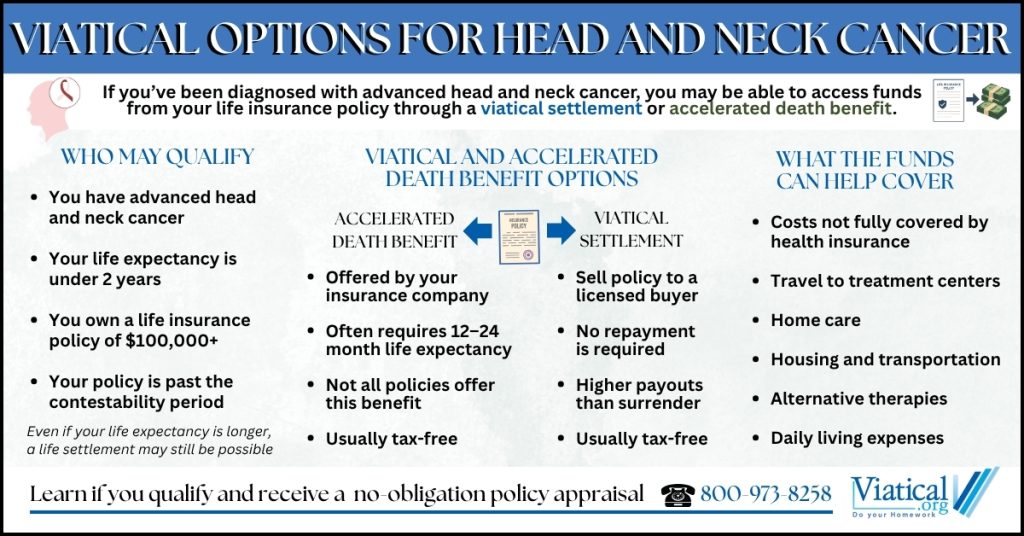
Many life insurance policies include a rider known as an accelerated death benefit (ADB). If a patient is diagnosed with a terminal illness and meets the policy’s criteria, typically a life expectancy of 24 months or less, they may be eligible to receive a portion of the death benefit while still living.
However, not everyone qualifies for accelerated death benefits. Some policies do not include this rider, and even when they do, insurance companies may have strict requirements. Certain carriers only approve the benefit for patients with a life expectancy of a few months to one year. It’s important to contact your insurer directly to determine eligibility.
ADB payments can be used for:
- Covering treatment costs
- Paying for in-home care or caregiving support
- End-of-life care
- Reducing financial stress for family members
The remaining portion of the death benefit is paid to the beneficiary upon the policyholder’s death. Policyholders should contact their insurance company to see if they qualify.
Viatical Settlements
Another option for accessing funds is a viatical settlement, which allows a patient to sell their life insurance policy to a direct buyer in exchange for a lump sum. This amount is typically much higher than the policy’s cash surrender value and can be used however the patient sees fit.
Patients with advanced head and neck cancer may qualify if:
- They have a life expectancy of less than two years
- They have a convertible term, whole life, or universal life policy with a face value of $100,000 or more. Other policies may qualify. It is always best to ask.
- The policy is no longer in the contestability period (usually two years after issuance)
Patients with a life expectancy longer than two years may still qualify for life settlements, which are similar to a viatical settlement, but available to individuals with chronic or serious illnesses who are not considered terminal.
Viatical settlements are not loans and do not need to be repaid. Funds are often used for:
- Medical expenses not covered by insurance
- Travel to cancer treatment centers
- Experimental therapies
- Relocation or living costs
- Supporting dependents or family members
In most cases, both accelerated death benefits and viatical settlements are tax-free for qualifying terminally ill individuals. However, every case is different, and a trusted tax advisor should always be consulted to understand the specific implications based on the patient’s unique situation.
Learn if You Qualify
If you or a loved one is facing advanced head and neck cancer, it’s important to understand all your options. Accelerated death benefits and viatical settlements can provide critical financial relief at a time when stability and peace of mind are most needed.
Please give us a call at 800-973-8258 for more information on accessing the value of your life insurance policy. A viatical settlement may offer financial support during treatment and allow you to focus on healing.
 DO YOU QUALIFY?