

Do beneficiaries have to agree to a viatical settlement? This is one of the most common questions policyholders ask when they are considering selling their life insurance policy for cash. Many people worry that moving forward with a viatical settlement requires permission from family members or that beneficiaries can block the sale. The answer is usually more straightforward than expected, but there are important details to understand before making a decision.
Who Has the Legal Right to Sell a Life Insurance Policy
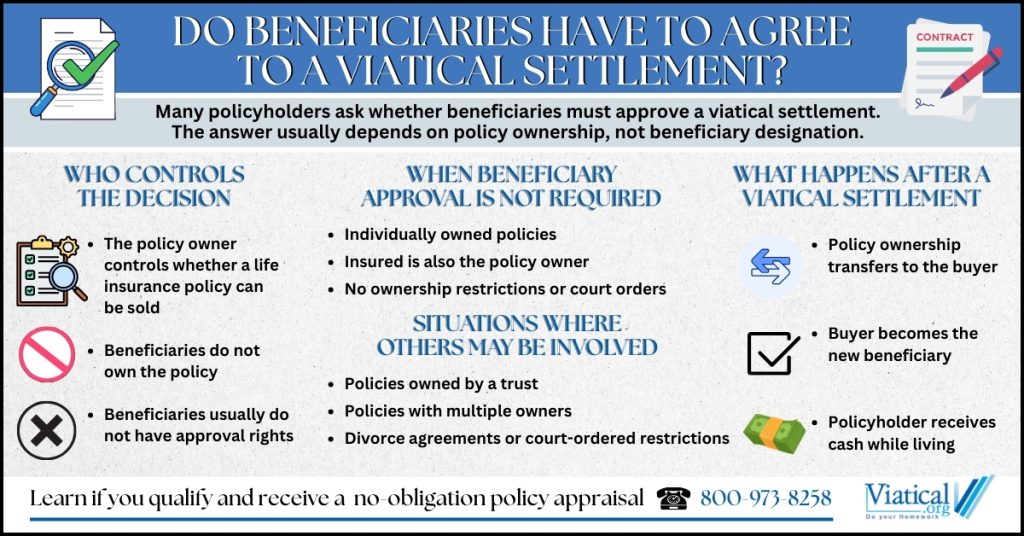
In most cases, the person or entity that owns the life insurance policy controls what happens to it. If you are both the insured and the policy owner, you generally have the legal right to sell the policy through a viatical settlement or life settlements. Beneficiaries do not own the policy. They have an expected future benefit, not a current ownership interest.
Because of this distinction, beneficiaries typically do not have to agree to a viatical settlement for the transaction to move forward. The decision rests with the policy owner, not the beneficiary.
When Beneficiary Consent Is Not Required
For most individually owned policies, beneficiary approval is not legally required. As long as the policy owner has the capacity to make financial decisions and all required disclosures are completed, the sale can proceed without beneficiary consent for viatical settlement.
This often surprises people. Many assume that because beneficiaries are named on the policy, they must sign off on major decisions. In reality, beneficiaries only have rights once a death benefit becomes payable. Until then, the policy remains an asset controlled by the owner.
Situations Where Beneficiaries May Be Involved
There are circumstances where beneficiaries may be involved in the process, even though their consent is not automatically required.
If the policy is owned by a trust, the trustee controls the policy rather than the insured or the beneficiaries. In those cases, the trustee must act in accordance with the trust’s terms. Depending on how the trust is structured, beneficiary interests may be considered, but the authority to sell typically rests with the trustee.
If a policy has multiple owners, such as in certain business or family arrangements, all owners may need to agree before the policy can be sold. In these cases, involvement is based on ownership rights rather than beneficiary status.
Court orders, divorce agreements, or prior legal arrangements can also affect who must participate in decisions involving a life insurance policy.
Why Policyholders Often Choose to Inform Beneficiaries
Even when beneficiary consent is not required, some policyholders choose to inform their beneficiaries. This is a personal decision rather than a legal obligation in most cases.
Communicating ahead of time can help avoid confusion or misunderstandings later. Beneficiaries may assume a policy is still in force and expect a future payout. Letting them know that the policy has been sold and converted into cash can provide clarity and prevent unnecessary distress.
How a Viatical Settlement Changes Beneficiary Expectations
Once a viatical settlement is completed, the original beneficiaries are removed because ownership and beneficiary rights transfer to the buyer. This does not mean beneficiaries are losing something they already owned. It means the future death benefit is exchanged for immediate funds for the policyholder.
For many families, this tradeoff provides important financial support while the insured is still alive. Instead of waiting for a benefit paid later, the funds can be used now for medical care, in-home assistance, housing costs, or other essential needs.
Key Takeaways for Policyholders
In most cases, beneficiaries do not have to agree to viatical settlements. The policy owner generally controls the decision to sell. However, ownership structure, trusts, shared ownership, or legal agreements can change who must be involved.
Understanding these distinctions can reduce uncertainty and help policyholders make informed decisions. A viatical settlement is a personal financial choice, and knowing who has authority over the policy allows that choice to be made with greater confidence.
To learn if you qualify and to obtain a no-obligation policy appraisal, please give us a call at 800-973-8258.
 DO YOU QUALIFY?