

These 2026 viatical settlement examples show how real policyholders have turned life insurance policies into immediate cash, often receiving far more than the surrender value or letting a policy lapse. Each case highlights how age, health, policy type, and face value can impact the amount a policy may be worth in the secondary market.
How These Examples Should Be Viewed
Every life settlement or viatical settlement is evaluated individually. Buyers review medical records, policy details, and premium obligations together to determine value. These examples are meant to provide realistic expectations, not guarantees. The only way to determine what a policy is worth is through a professional review.
Real 2026 Viatical Settlement Examples
High-Value Policy with Serious Illness
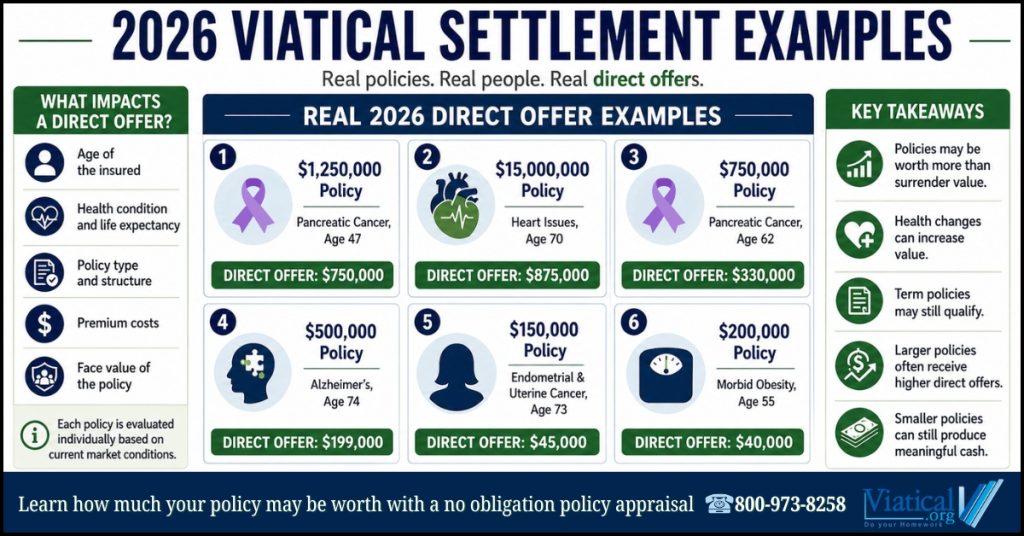
A 47-year-old policyholder diagnosed with pancreatic cancer owned a $1,250,000 convertible term life insurance policy. Rather than continuing coverage, they chose to sell to a direct buyer and received $750,000 in cash.
This example shows how a serious diagnosis can significantly increase a policy’s value, even when the coverage is term. Convertible term policies can be particularly valuable when they allow access to permanent coverage features that buyers prefer.
Large Universal Life Policy with Health Issues
A 70-year-old with heart-related health issues held a $15,000,000 universal life policy. The ongoing premium requirements had become substantial, and the policyholder no longer wanted to maintain the coverage. After selling the policy, they received a direct offer of $875,000.
Larger face-value policies often attract more buyer interest, especially when paired with declining health and rising premium costs.
Mid-Size Policy with Terminal Diagnosis
A 62-year-old diagnosed with pancreatic cancer owned a $750,000 convertible term policy. They completed a viatical settlement and received $330,000 direct, without having to subtract broker fees.
This type of scenario is common in viatical settlements, where a serious illness allows policyholders to access a meaningful portion of the policy’s value during their lifetime.
Moderate Policy with Cognitive Decline
A 74-year-old with Alzheimer’s disease had a $500,000 convertible term policy and received $199,000 from the sale to a direct buyer.
This example illustrates how chronic and progressive conditions can qualify for a settlement, even if the policy is not extremely large.
Smaller Policy Still Producing Value
A 73-year-old owned a $150,000 universal life policy and received $45,000 cash after selling it.
Policies with lower face values are often overlooked, but they can still produce meaningful cash, particularly when the insured meets age and health criteria that buyers consider favorable.
Non-Traditional Qualification Scenario
A 55-year-old with morbid obesity held a $200,000 convertible term policy and received a direct offer of $40,000.
While not every case involves a terminal illness, certain chronic health conditions may still qualify depending on how they affect life expectancy and overall underwriting evaluation.
What These Examples Show
These 2026 viatical settlement examples highlight several important patterns:
- Health plays a major role in determining value
- Larger policies tend to generate higher payouts, but smaller policies can still qualify
- Convertible term and permanent policies are often eligible
- Premium burden can influence the decision to sell
Most importantly, these examples show that policies many people assume have little or no value can often be sold for a significant amount.
Why Policyholders Consider a Viatical Settlement
Policyholders typically explore a viatical settlement when:
- Premiums become difficult to maintain
- Health conditions change financial priorities
- Coverage is no longer needed for its original purpose
- They want to access funds instead of letting the policy lapse
Letting a policy lapse or surrendering it to the insurance company often results in little or no return compared to what may be available through the secondary market.
The Next Step
These examples provide a clear picture of what may be possible, but every case is different. The only way to understand a policy’s true value is to have it reviewed based on current market conditions.
If you are considering selling your life insurance policy, starting with a no-obligation viatical or life settlement appraisal allows you to see real direct offers and make an informed decision based on your specific situation. Please give us a call today at 800-973-8258. We have been helping policyholders access the hidden value in life insurance for over 20 years and would be happy to help you too.
 DO YOU QUALIFY?