

If you are considering a viatical settlement, one of the first things you will want to know is what documents are needed for a viatical settlement and how long it will take to gather them. The good news is that most of the paperwork is straightforward, and in many cases, you already have some of it. The goal is to verify the life insurance policy details, confirm who has the legal right to sell it, and provide medical information that supports eligibility.
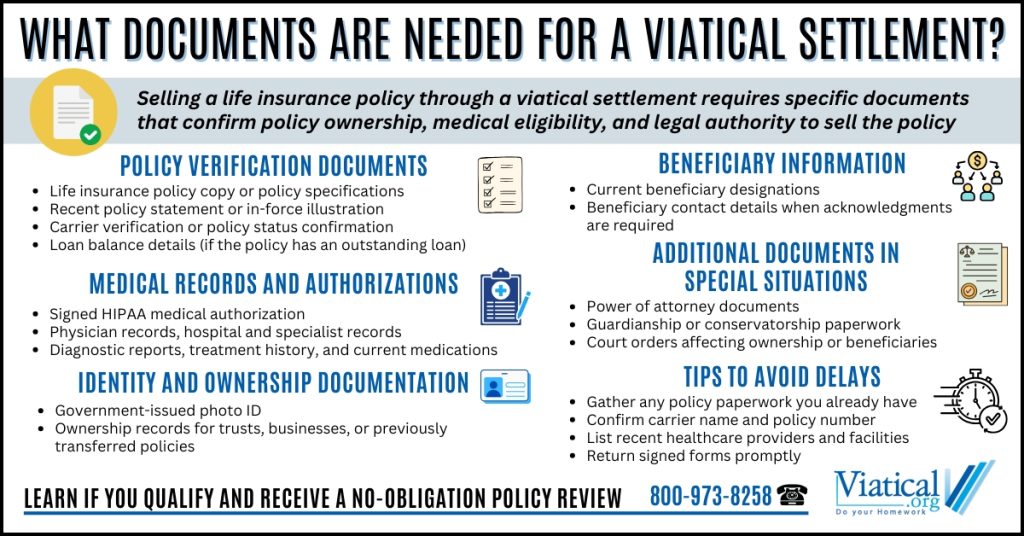
Basic Policy Documents
These documents confirm what the policy is, who owns it, and what the current status looks like.
- A copy of the life insurance policy (if you have it). If you do not, the carrier can usually provide a replacement copy.
- An in-force illustration or schedule of premiums. This helps show premiums, cash value (if any), and how the policy is expected to perform. Typically, you won’t need to request this yourself. Life settlement companies will request specific illustrations to evaluate potential value.
- A recent policy statement showing current details like face amount, policy type, and premium schedule.
- Carrier verification forms (often handled through an authorization you sign). This lets the buyer confirm the policy is active and in good standing.
If your policy has a loan, you may also be asked for loan balance details so the net value can be evaluated accurately.
Proof Of Identity and Ownership
A viatical settlement is a legal transfer, so identity and ownership documentation matters.
- Government-issued photo ID (such as a driver’s license or passport)
- Ownership documentation if anything is unclear, such as a past ownership change or trust ownership
If the policy is owned by a trust, business, or another legal entity, additional paperwork is usually required, such as trust pages that show the trustee’s authority or business documentation showing who can sign.
Medical Records and Medical Authorizations
Medical documentation is a major part of a viatical settlement because eligibility is driven by health status and life expectancy.
Typically required items include:
- HIPAA-compliant medical authorization allowing medical records to be collected
- Physician records related to the qualifying condition, including diagnosis details, treatment history, and prognosis notes
- Hospital records if there have been recent admissions, surgeries, or major procedures
- Pathology reports, imaging reports, or specialist notes when relevant to the diagnosis
- Medication lists and treatment plans (often included within the records)
In many situations, you do not need to personally track down your medical records. You sign authorizations and the records are requested directly from your providers. The most common delays come from slow medical record departments, missing provider contact information, or records spread across multiple facilities.
Beneficiary Information
You may be asked for:
- Current beneficiary designation information (often confirmed through the carrier)
- Beneficiary contact details in situations where signatures or acknowledgments are required under state rules
Even when beneficiaries do not need to sign, it is still important to confirm the beneficiary setup because it impacts how the policy is structured today and avoids surprises during verification.
Additional Documents for Special Situations
Some cases require a few extra items. These are common examples:
- Power of attorney documents if someone is signing on the insured or owner’s behalf (the POA must typically grant authority for financial and insurance transactions)
- Guardianship or conservatorship paperwork if a court has appointed someone to act for the insured or owner
- Divorce decree or court orders if the policy ownership or beneficiary arrangement was affected by legal agreements
- Banking information for receiving
How To Make the Paperwork Go Faster
If speed matters, these steps usually help:
- Locate any policy paperwork you already have, even if it is incomplete.
- Write down the carrier name, policy number, and the insured and owner names exactly as shown on the policy.
- List all medical facilities you’ve visited in the past 12–24 months so records can be requested promptly.
- Respond quickly to signature requests, especially medical authorizations.
A Practical Way to Think About It
A viatical settlement file is basically built around three confirmations: the policy is real and transferable, the seller has the right to sell it, and the medical documentation supports eligibility. Once those pieces are documented, the transaction can move forward far more smoothly.
To learn if you may qualify for a viatical settlement or life settlements, please give us a call today at 800-973-8258. It only takes a short 5-10 minute phone call to learn if you’re eligible.
 DO YOU QUALIFY?